
The first call with a private label perfume factory is a screening conversation, not a negotiation, and it goes better when you arrive with a small prepared pack. Buyers who bring a defined product, a volume range, a target price, a market list and two or three reference scents get useful answers within twenty minutes. Buyers who open with the intention to launch a perfume get a catalogue and a generic quotation, and often mistake that for progress.
Key takeaways
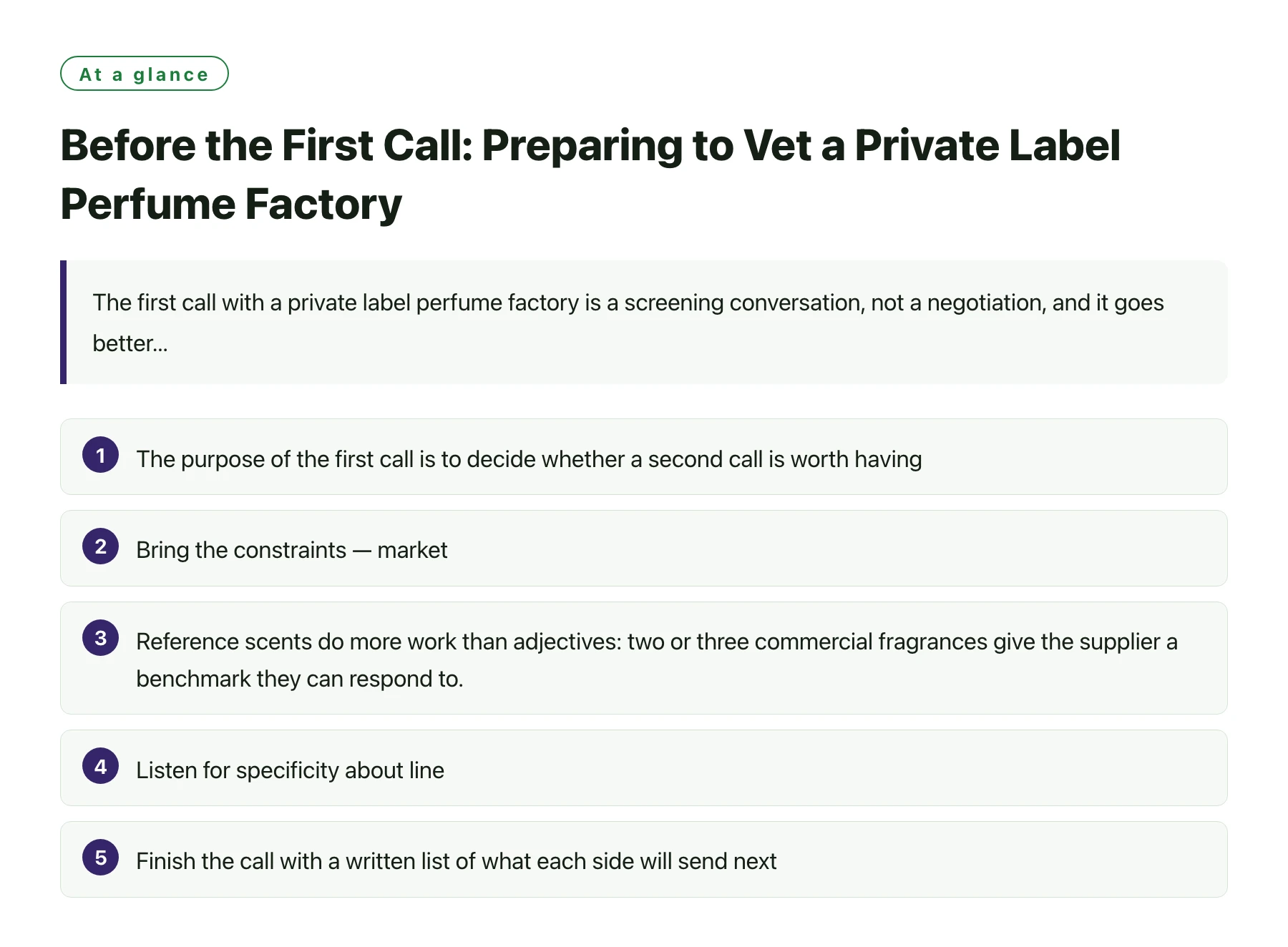
- The purpose of the first call is to decide whether a second call is worth having, so prepare questions rather than a pitch.
- Bring the constraints — market, price ceiling, volume range, format — because they determine which of the factory's ranges is even relevant.
- Reference scents do more work than adjectives: two or three commercial fragrances give the supplier a benchmark they can respond to.
- Listen for specificity about line, capacity, materials and documentation; general reassurance is the default answer and carries little information.
- Finish the call with a written list of what each side will send next, and a date for it.
Private label sourcing is attractive because it compresses development: the scent comes from an existing library, the packaging from a qualified range, and the brand concentrates on positioning. That compression only works if the factory understands which range is relevant to your product, and that is what the first call is for.
The mistake most first-time buyers make is treating the call as a presentation. They describe the brand at length, ask whether the factory can help, and receive a catalogue in return. It feels like a productive conversation and produces no decision-relevant information.
A prepared buyer does the opposite. They arrive with a short pack of constraints and references, spend most of the call listening, and leave with specific answers about capability, minimums, timelines and documents.
What the first call can and cannot establish
One conversation cannot tell you whether a factory is good. It can tell you whether the factory's routine matches your order, and whether the people answering can be specific about their own operation. Those two things are enough to decide whether to invest in samples.
Being clear about the limits of the call prevents two opposite errors: dismissing a capable supplier because the sales contact was poor, or committing to a supplier because the conversation was pleasant.
What it can establish
Whether the factory regularly produces your category and format, what its minimum order looks like, how it describes its own capability, who the technical contact would be, and which documents it supplies as standard. Each of these has a concrete answer, and vagueness on any of them is itself informative.
What it cannot establish
Whether the quality system is consistently applied, how the factory behaves when a batch fails, or how a schedule holds under pressure. Those questions are answered by records and by a trial order, not by a call. Do not try to settle them in the first meeting; note them for the next stage.
Who should be on the call
Whoever holds the commercial decision should be present, along with anyone who will own the technical relationship. Bringing four stakeholders with overlapping interests slows the conversation and dilutes the answers. One decision-maker, one technical listener and a written agenda is the productive shape.
The preparation pack to bring
- A one-page product definitionCategory, format, concentration or strength direction, target customer, and whether the scent is to come from the factory's library or be developed. Half a page is enough, and it forces the internal decisions that would otherwise surface mid-project.
- A volume range, not a single numberState a first-order quantity and a realistic annual range. Minimum order quantities, packaging choices and pricing bands all depend on this, and a range lets the factory suggest a sensible entry point.
- A target retail price and a cost ceilingThese two numbers define the material palette and the packaging options the factory can propose. Withholding them produces a beautiful proposal that cannot be made at your price.
- A market listName the countries you intend to sell in first. Market obligations reach into labelling, documentation and testing, and the brand usually retains the responsible-party duties rather than the factory [1].
- Two or three reference fragrancesCommercial products the supplier can obtain or recognise, with a note on which aspect of each matters. This is more useful than a paragraph of adjectives and gives an immediate basis for a library recommendation.
- A short question listLine and capacity, standard minimum order, packaging options, testing scope, documentation supplied, formula ownership and confidentiality terms, and lead times for a first order. Written questions get written answers.
What a useful answer sounds like on each question
| Your question | A weak answer | A useful answer |
|---|---|---|
| Can you produce this category and format? | Yes, we do everything | A specific mention of comparable products, the line involved and any part that is outsourced |
| What is your minimum order? | It depends | A number for the scent and a separate number for each packaging component, with the reason |
| Which tests do you run? | All standard tests | A named list, plus which are performed in-house and which are commissioned externally [2] |
| Who owns the formula? | It is not something you need to worry about | A clear position on ownership, exclusivity and confidentiality, in writing |
| What happens on a first order? | We will take care of it | A stage list with lead times, approval points and the documents supplied at each step |
| Can we see the facility? | Of course, whenever you want | A scheduled walkthrough or video call covering the filling area, warehouse and retained samples |
The middle column is not evidence of dishonesty. It is what a sales conversation sounds like when the other side has not yet decided whether your order is worth the detail. Prepared questions move the conversation into the right column quickly, and if they do not, you have learned something useful.
Two documents are worth asking about on the first call even though they will be read later. The first is the standard position on formula ownership and confidentiality, because WIPO guidance on contracts treats these as matters to be recorded in writing rather than settled by understanding [3]. The second is the format of the batch record and retained reference, because it shows whether quality is described as a system or as an intention. Leave the call with a written summary of who sends what next and by when — a pack, a sample list, a pricing band or a facility slot. A supplier that meets those small commitments promptly is giving you the most reliable preview available of how a production order will go. Buyers comparing manufacturers for a men's line often find the difference between candidates shows up first in this part of the process, which is why it is worth reading how a supplier presents itself publicly — as Xuelei does — and then testing whether the call matches. For a structured route into private label work, it also helps to understand what a a private label partner for perfume lines takes on compared with a factory that sells components only, and how their OEM/ODM manufacturing services are usually scoped. The first call is where those distinctions become visible.
Sources
- European Commission: Cosmetics in the EU —— The European Commission's overview of EU cosmetics rules, including the responsible person, product information file and safety report requirements.
- SGS: Cosmetics, Personal Care & Household Testing —— Testing, inspection and certification services for cosmetics and personal care, including microbiological, stability and safety testing aligned with cosmetics GMP.
- WIPO — World Intellectual Property Organization —— The UN agency for intellectual property; resources on industrial design and patent protection relevant to product and packaging design.
Frequently asked questions
How long should the first call with a perfume factory take?
Thirty to forty-five minutes is usually enough to establish fit, minimums, capability and the next step. Longer calls often indicate that the supplier is presenting rather than answering, or that the buyer has arrived without defined constraints.
Should I ask for pricing on the first call?
You can ask for a band, given your volume range and format, but expect a range rather than a firm figure. A precise price offered before the packaging and volume are defined is not a price; it is a starting point that will move.
What if the supplier cannot answer technical questions on the call?
That is common when the first contact is a salesperson. The useful response is to request a follow-up with the technical lead and watch how quickly it is arranged — the response time tells you more than the unanswered question.
How many suppliers should I speak to before choosing?
Enough to compare answers on the same set of questions. Two or three prepared conversations usually reveal a clear difference in fit, which is more useful than a long list of introductory calls.
Do I need a brief before the first call?
A full brief is not necessary, but a one-page product definition is. It sets the constraints the supplier needs in order to answer usefully, and it prevents the call from becoming a general discussion about the fragrance industry.
What should happen right after the call?
Write a short summary of what was said, including any commitments and dates, and send it to the supplier for confirmation. This creates a record, tests whether the answers were accurate, and sets the tone for how the project will be documented.